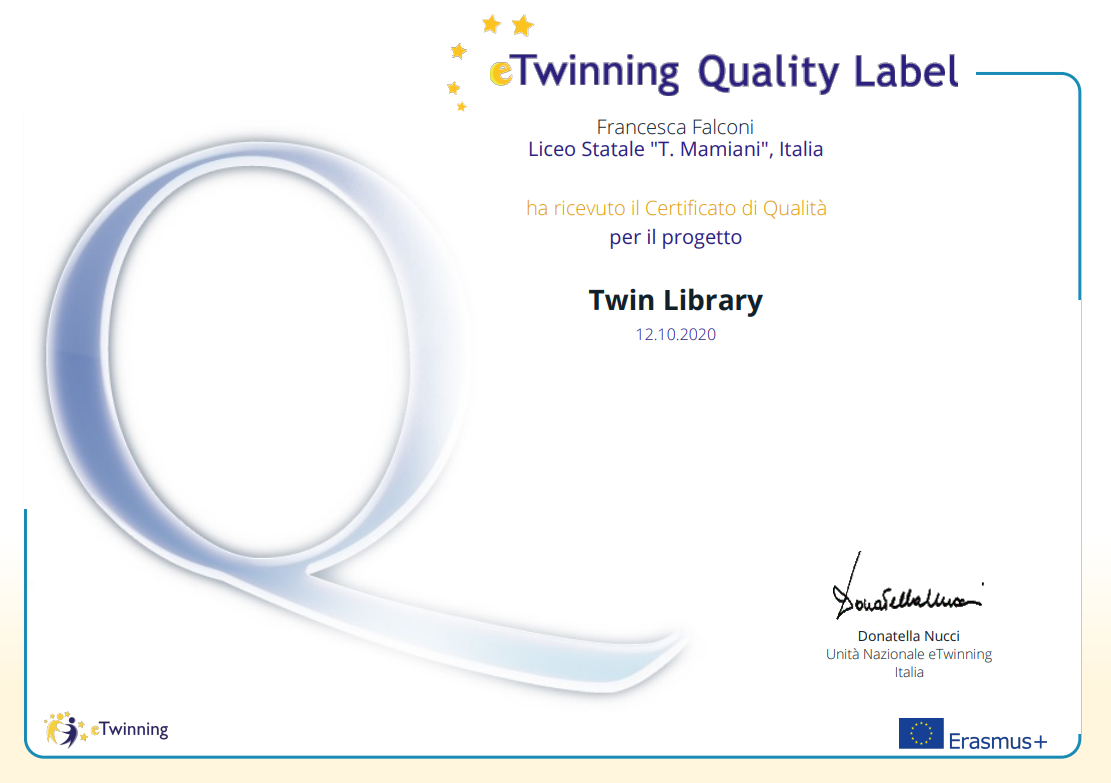
Today we have been awarded with another National Quality Label for the project Twin Library! Great success for our team of teachers and students!
Showing posts with label 2019/2020. Show all posts
Monday, 12 October 2020
National Quality Label for the etwinning project Twin Library
Friday, 9 October 2020
National Quality Label for the project 'Listen to my radio: breaking news!'
Great news today! The eTwinning project 'Listen to my radio: breaking news' that the class 2EL (now 3EL) carried out over the last school year has been awarded the National Quality Label.
It's a great achievement for us, as it was really challenging and we did plenty of interesting and demanding activities. Way to go!
Have a look at the project clicking on https://twinspace.etwinning.net/91664/home
Friday, 6 March 2020
William Shakespeare: The Bard
Homework due on Monday 9th March
William Shakespeare is the most well-known English writer all over the world.
Playwright,
poet, actor and entrepreneur, he is the undiscussed genius of the English language capable
of bringing to life unforgettable lines and characters that are part of our
collective memory.
Follow me
through this virtual journey and do the activities that will guide you to
discover the Bard.
1) Why
study Shakespeare?
Browse the
following websites and find 5 evidences/reasons for Shakespeare's influence and
legacy on our life? What have you discovered? Make notes and bring them to
class.
2) Shakespeare
and English language
The following
picture shows some of the things we say today that were invented by Shakespeare
Find 5
expressions contained in his plays by entering them in the "text search" space in the following website which hosts all Shakespeare's works. Which works are they contained in? Write the result on your copy book.
3) Read your literature book at page 79 (Shakespeare's Canon). In how many groups are his plays divided and why? Mention the features of each group and at least 3 major plays.
Monday, 17 February 2020
3L: The Gun Powder Plot
Homework due on 2nd March
Remember, remember! The fifth of November, The Gunpowder treason and plot; I know of no reason why the Gunpowder treason should ever be forgot!
These are the first lines of a famous English folk poem that celebrates the failure of ......what?
What has to do the picture above with English history and culture?
Let's find out more by watching the following video and by doing the tasks.
1) Watch the video and answer the questions
- Who was Guy Fawkes?
- Which army did he join?
- What did he ask the King of Spain for?
- What did the plot consist in?
- What was one of the conspirator worried about?
- What did the King do?
- What was crazy?
- What do British celebrate on 5th November?
- Which discrepancy exists between the real history and its celebration?
- How do British families celebrate Guy Fawkes night?
Thursday, 6 February 2020
New lesson for the SID 2020
Like every year, in February Safer Internet Day is being celebrated all around the world.
This year it' will be on 11th February.
Here is a new lesson about digital footprint, that I have prepared for my 2nd year students (aged 15-16) . Last year we talked about cyberbullying.
Monday, 25 November 2019
1EL: Irregular verbs
For your class test about irregular verbs you will have to learn all the list of verbs at page 220 of your book "Language for life" and of your Grammar book.
This is a list of exercises you can do to get ready for the test.
https://www.englisch-hilfen.de/en/exercises_list/verbs.htm
http://www.englishexercises.org/makeagame/viewgame.asp?id=2030
https://www.ego4u.com/en/cram-up/grammar/irregular-verbs
https://englishpage.com/irregularverbs/index.htm
http://www.learnenglishirregularverbs.com/
This is a very useful web site to learn how to pronounce the verbs correctly
http://english-irregular-verbs.blogspot.it/2010/07/english-irregular-verbs-16_4738.html
Sunday, 24 November 2019
Robin Hood: a Medieval Folk Hero
Robin Hood is a popular medieval outlaw, whose story is told by some ballads dating from 13th and 14th centuries.
What do you know about him? Have you very ever watched a movie or cartoon about him?
Let's find out more about this intriguing folk hero, who has been fascinating many storytellers and film directors.
Task 1. Read the paragraph "England" contained in the entry Outlaw from Wikipedia and answer the questions:
1. Who was an outlaw?
2. Why was someone declared outlaw?
3. Where and how did outlaws live?
4. Which punishment was inflicted to anyone who killed an outlaw?
5. Did a man need to be guilty of the crime for which he was declared outlaw?
6. What is common law?
Task 2. Read the text and say if the following sentences are True or False (copy them on your exercise book). Correct the False ones.
https://www.biographyonline.net/british/robin-hood.html
2. The early sources of this legend are ballads
3. Robin Hood lived certainly in Sherwood Forest near Nottingham
4. In early accounts Robin Hood is a devoted churchgoer of noble origins who fights the injustice of his fellows.
6. One of his long-standing enemy is the Sheriff of Nottingham
7. In Piers Plowman, an allegorical narrative poem by William Langland, Robin Hood is placed in the 12th century.
8. Robin Hood was probably a noble unfairly dispossessed of his land.
9. All the characters traditionally included in the legend are already mentioned in the early ballads.
10. In the Victorian Era (19th century) an influential work was published which depicted Robin Hood as a philanthropist.
Task 3. Watch the video. Where does the Robin Hood we know today come from? How is Robin Hood portrayed and what does the story describe?
Labels:
2019/2020,
2020/2021,
3EL,
3LL,
literature
Subscribe to:
Posts (Atom)


